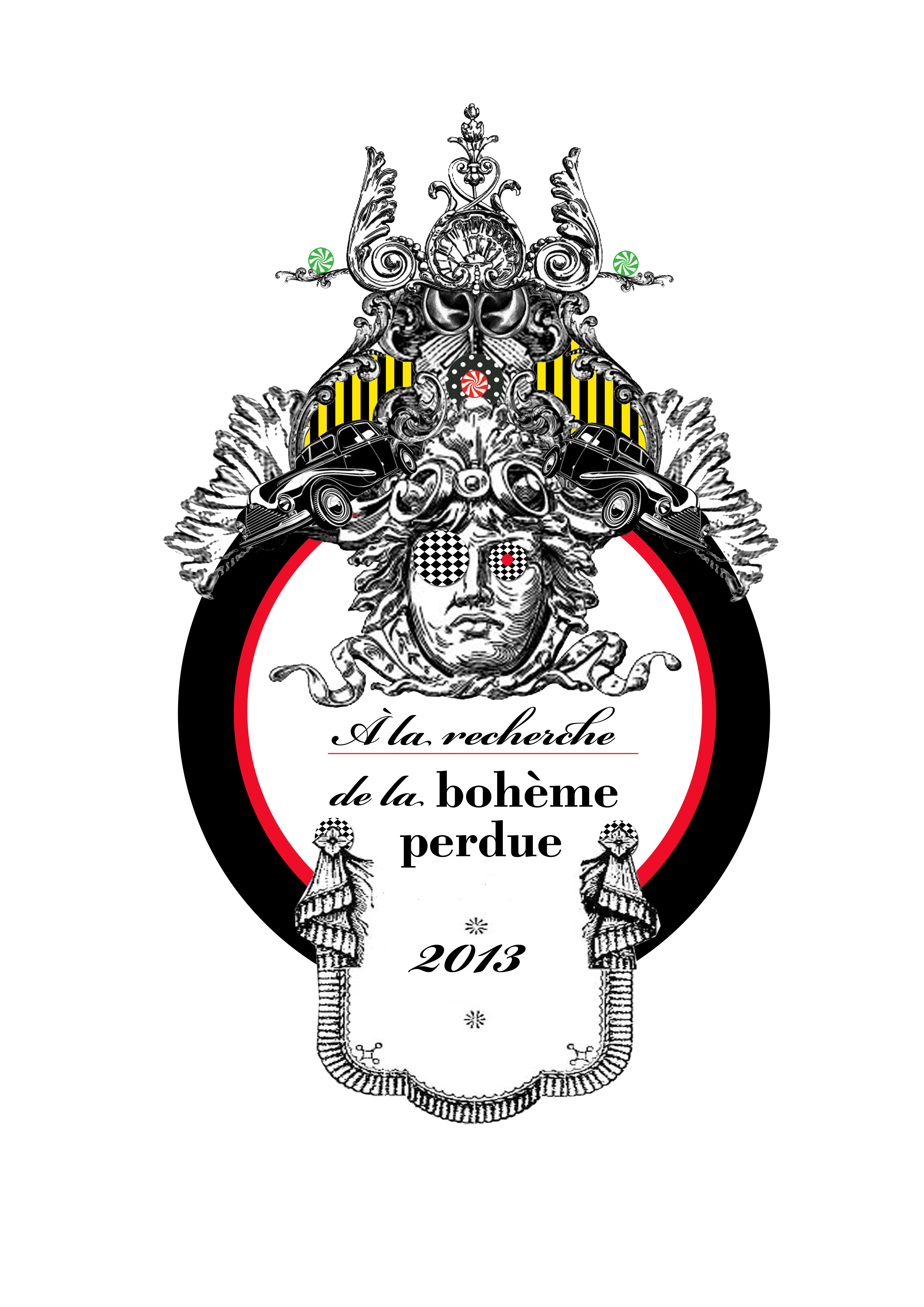
À la recherche de la bohème perdue
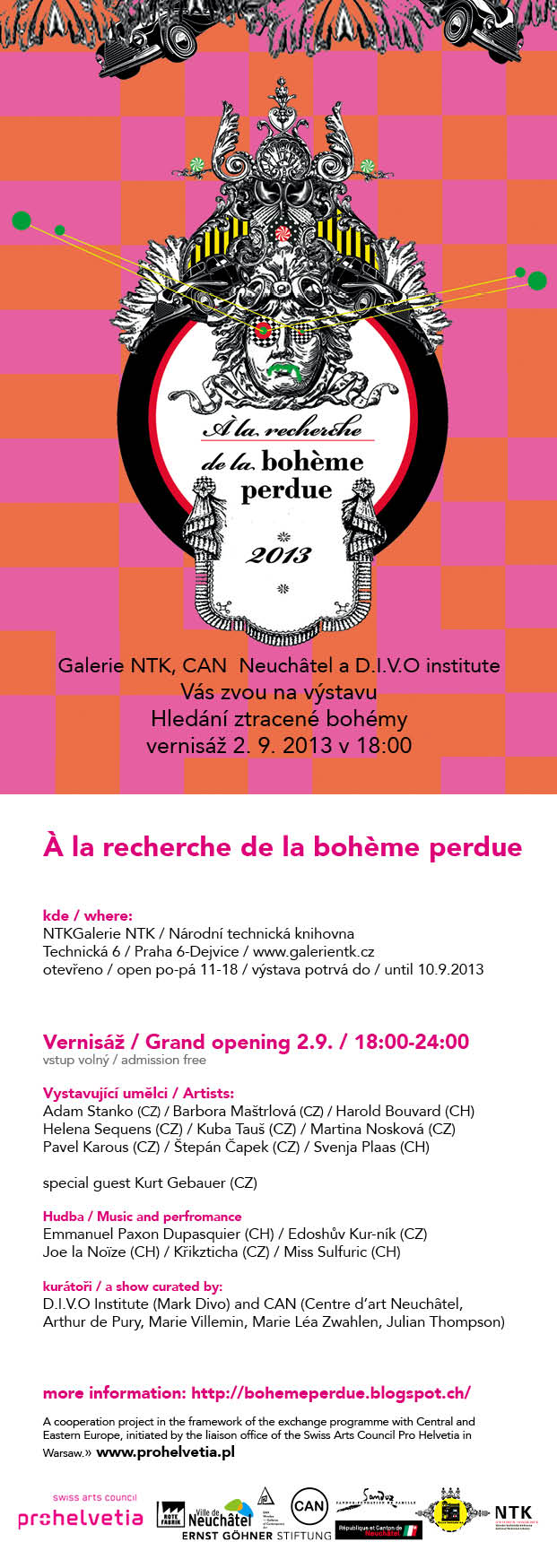
Before we start to take a look at the evolution of the contemporary art scenes in Switzerland and the Czech Republic since the fall of the wall in 1989, we should be aware which kind of approach each protagonist has towards the other in this day and age. For us in Switzerland, this means, working with institutions and artists from a so-called "ex east block country" or “former east”[1]. These terms are of course totally anachronistic labels, as they refer to a political block that no longer exists. Like always our point of view is defined from a situation, because if we are speaking of former east or soviet block countries or societies, why do we never refer to our country as former west or ex western block countries? Does this ghostly notion of the East persist only because of our inability to define new terms that are able to grasp the present? Or do we cherish nostalgia, hoping to indirectly connect to the spirit of long-gone ideologies? The first thing that went away after the fall of the soviet block was the fact that the world was divided into two systems which were separated by different ideological constructions. Because cultural exchange was prevented by the iron curtain, we started to acquire more and more nostalgic and feelings towards the places we would never be able to visit. Maybe this is the reason why we like to refer to the former east countries because it seems to us better than any cynical postmodern definition of the current state of affairs in these societies. And as long as we haven’t been able to invent something more positive or constructive than postmodernism, we’ll have to deal with our part in this nostalgia.
We can accept a little bit of nostalgia, but revealing ones own exoticism is something that seems to be a bit more dangerous. Exoticism always implies that one is endorsing the colonial inheritance and crude and vulgar concepts of orientalism, while assuming ones own position at the center of the universe. Denying our craving for exoticism, by covering it up behind a well-intentioned neo-humanist discourse will only make matters worse, and will never get us to a point were we can free ourselves from our western centered point of view. We are not going to criticize exoticism in itself, but we have to take a close look from where the exoticism stems and what it is linked to. Having an exotic idea of the former east while living in the former west, is an anachronic position and can’t be held up, as both systems are now one. When we refer to an exotic place in using the words “former” or “ex”, we place it within the past, so in fact our exotic terminology refers to what we were, not towards what the exotic society is today. So we end up with an anachronistic endo-exoticism, something that has also been called “interior exoticism”[2]. According to the principle of phenomenal existence, everything we do is based on representation, and that we conceive ourselves differently than we actually are. If our research is based on a passé geopolitical notion, we will end up with a blurred image of an individual exoticism. We came to know a lot about a world that would remain forever inaccessible, and through this the so-called east had a presence-absence. Are we forced to acknowledge an absence of absence.
Czechoslovakia’s counterculture before 1989 offered a fascinating array of different artists, and art forms. Again for geopolitical reasons the Czech underground groups like Plastic People of the Universe received extensive media coverage in the west, and dissidents like Vaclav Havel became household names. After the fall of communism, the protagonists of the counterculture movement moved into the highest offices. When the tables turned, the Prague underground scene lost its main figures to the institutions. This shift didn't empower the independent culture producers and artists, as the newly appointed culture officials had no interest in empowering critical voices around them. The most extreme example of this development is perhaps the curious case of the former dissident and fluxes artist Milan Knizak, who was appointed director of the national gallery, and because of his abuse of power became one of the most controversial figures among artists and the Czech public.
But there still is a lively and vibrant art scene in Prague that is mainly unknown to the western public. One of the missions of the project is to present and connect artists, activists and institutions that are shaping the Czech art scene to the Swiss public. Switzerland in turn is known to Czechs as the land of banks and cleanliness, things that are not usually associated with counterculture. But Switzerland had and has a strong underground scene, which has always been at the forefront of changes made within the setup of the society. Today a city like Zurich is ruled by a mayor who takes pride in saying that she was a member of the youth movement of the 80ties.The economic success story of Switzerland is also due to its open civil society, empowered by grass roots movements, which often questioned the authority of the state. The Zurich squatting scene is one of these movements, and is driven by artists and culture activists. On our quest for the lost bohemians, we would like to present the Czech public the techniques and persons of these groups.
The best way to start the nostalgic search for lost bohemianism is most likely a voyage by land, traveling slowly in a vehicle and stopping on the way. The CAN and the D.I.V.O. Institute intend to create a mobile art space, consisting of a refurbished bus, and two army tents. These tents will form the backbone of the so-called mobile inhabited sculpture and is a collaborative artwork to which other artworks can be added and subtracted. The inhabited sculpture is also the backdrop for any actions, and through its mixed authorship it defies the idea of art as just being a mere commodity for rich investors. During the journey the installation in and around the mobile platform will grow, and at each stop its appearance will change.
We will take the road to Bohême. The word Bohême (fr, the region “Bohemia”) in an explicit reference to the movement bohème (“bohemianism”) which was a French counterculture in the late 19th century. The movement of the bohème rejected romanticism, an idea which they considered to be the emanation of the bourgeois culture. Let us note that a first contradiction appears in our projects historical references: searching for the bohème perdue (“lost bohemianism”) on a journey is not exempt of romanticism (let us not forget that romanticism was developed from, amongst other things, Grand Tourists’ travelings of the eighteenth century). One of the main differences between these two types of travelers (bohémiens and Grand Tourists) was of course the amount of money that could be spent on a voyage. Our cultural pilgrimage will try to follow and avoid both these types of travel.
The bohème française (“French bohemianism”) strongly influenced authors such as Hermann Hesse. Hesse spent a lot of time researching an elsewhere that he was attempting to find between the Orient and Occident. In following different branches of influence reconstructed by historians, bohème would be one of the sources of Dadaism, another branch passing through Hesse, leading to the Wandervogel movement to then pass to the United States and the Beat Generation, to culminate in writers like William S. Burroughs or, a bit later, Philip K. Dick. Elsewhere in hence no longer the same, it is no longer between two cultures, political systems or regions. The search for elsewhere is found in the Inter-zone, the intermediary between fiction and reality.
What ever became of the bohémien elsewhere in today’s contemporary art scene? We are obviously tempted to search within alternative or independent structures, in so called off spaces. In Switzerland there are many such places that proclaim themselves as counterculture. At the same time these same places receive grants from foundations such as Nestlé pour l’Art, the same organization that also funds museums, opera festivals and other large institutions showing high bourgeois culture. The term bobo[3], a contraction, of “bourgeois” and “bohème”, describes this contradiction, with a schizophrenic aftertaste. Counterculture and establishment view each other in similar way the opposing east and western blocks used to eye each other. Established institutions take elements from the counterculture, and the outcome of the discussions in museum and off spaces are often identical: contemporary art always should be critical and experimental.
In setting off à la recherche de la bohème perdue, we would like to take a look at the different contradictions of high and low, east and west, taking into account our endo-exotic side, nostalgic side, and maybe even the bobo character of our action. Thus, the first and third phase of the project will show one of these contradictions by confronting one exhibition of an institutional nature with an event that plays with counterculture’s accepted codes. The utopian goal of the project consists of creating a shock between the two, a shock that should allow the appearance of a fissure giving access to an inter-zone beyond our contradictions.
The CAN and Mark Divo
[1] The notion of “former west” was developed in a research project led by the BAK (basis voor aktuele kunst, Utrech). q.v. www.formerwest.org
[2] Victor Segalen in his « Essay on exoticism”, Claude Cahun, Jules de Gaultier, among others.
[3] The term bobo was coined by David Brooks to describe the descendants of yuppies in the 1990s.
more info:
http://bohemeperdue.blogspot.cz